Showing posts with label Dave Trott. Show all posts

Monday, 16 November 2015

The best visual aids for a business presentation are often cheap and impromptu

I have always been very much in favour of using visual aids in business presentations – there is plenty of research to indicate how powerful they can be in terms of making your message both understood and remembered – but the aids that are most effective of all are often those that are cheap and impromptu.

Possibly the best use of a visual aid that I have ever seen was in a presentation by a Fund Manager. In response to a question, he reached for a scrap of flimsy paper and drew a very simple graph with just two axes and one line. He then held the piece of paper close to his face and guided his audience through the movements on the graph using his pencil as a pointer. By doing so he created a ‘single point of focus’ - him and his graph all in one ‘tight shot’ - and he never broke eye contact, making his delivery highly compelling.

The reason he was able to hold eye contact was that the scrap of paper was so flimsy that he could see through it and therefore knew exactly where he was pointing at any given moment. What underpinned the powerful delivery technique was that it all looked as though this thought had just occurred to him and that he had drawn the graph especially for this audience to answer their specific question. In other words, it was not a carefully thought out piece of PowerPoint to be rolled out to all and sundry.

In reality, of course, the ‘graph on a scrap of paper’ was central to his regular repertoire, and an essential part of his preparation for meetings was to ensure that some scrappy paper and a pencil were close to hand. If the paper provided was too thick he would send out for something cheaper!

I am not one to advocate abandoning PowerPoint altogether – you should use whatever helps to get your point across to this particular audience on this particular occasion. But imagine how powerful some cheap and impromptu aids can be if you are using them to break away for some more sophisticated aids that are clearly pre-prepared.


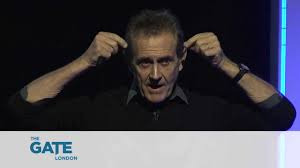
It nevertheless begs the question as to how far you can or should adopt the cheap and impromptu principle. For inspiration you might like to look below at a presentation given by my advertising hero Dave Trott (Click on the link under the picture). He delivers the whole thing by doodling on an overhead projector (remember them?)!  You will soon see, however, that it suits his ‘Wise Old Cockney Geezer’ character so much better than anything that PowerPoint could ever provide.


Thursday, 18 June 2015

Lack of Creative Thinking makes the big news issues fester – it’s time to appoint Dave Trott as Minister for Creative Solutions

Watching the news tonight I was dismayed at the complete lack of creative thinking currently being applied to some high profile issues. I should declare upfront that, alongside my work as a Presentation Skills coach I train PR people in Creative Thinking.

Take the first issue – the government ‘s early – albeit flagged in the manifesto – withdrawal
from subsidising onshore wind energy facilities. NIMBYism is apparently one of the big problems – people just don’t like the look of the giant propellers than generate a cheap, clean energy. There was much talking around the subject but no one seems to be considering this: what might be done to make them more attractive? We like the look of windmills – artists paint pictures of them and they make the landscape look beautiful. Might there be a way of achieving a similar result with the modern day version? The answer may be no, but let’s at least consider it.

Issue number two – the Palace of Westminster is crumbling. It’s going to cost between three and seven billion – yes, billion - pounds to repair it.  Depending on various options it could take anything from six to thirty-two years to complete the work. What is missing from this information? Answer: how much it would cost and how long it would take to pull the whole thing down and start again with a building more suited to today’s needs.

Now, no one likes a bit of history and heritage more than me and I would be very sad to see the wrecking balls applied to the ‘Mother of all Parliaments’. But if you are going to have a proper debate you need to consider all the options, including the so-called ‘nuclear’ options. Considering extremes is a very effective way of both stretching the imagination – you think of all kinds of potential solutions; some of them will be a bit mad and you may not actually use any of them, but it will help to bring fresh thinking to the problem. Extremes are also useful for putting things into perspective. It might be, for instance, that it is cheaper to repair than to rebuild, in which case the current shocking figures can be presented as a bargain. It might be that it is slightly more expensive to repair than to rebuild, in which case the whole focus can be on the difference between the two costs rather that just one big, horrific number.

So we are now getting into communication issues here as well as the need for creative thinking – which is why the whole thing both fascinates and frustrates me.


I have a quick, potentially highly effective solution to propose. Have a dip into any of these books:  One + One = Three, Predatory Thinking and Creative Mischief. You will soon see that their author, the advertising legend Dave Trott, is brilliant at thinking sideways and back to front – never mind outside the box – to come up with solutions to any kind of challenge. Give Dave a peerage and appoint him Minister for Creative Solutions without delay.


Tuesday, 12 May 2015

Catch the ‘conversational asides’ to make your presentation truly engaging and impactful

I have written before about the benefits of speaking your words out loud as you create a presentation. It makes it all the more fluent and manageable. Above all, though, it steers you clear of dressing your words in a ‘cloak of formality’, as tends to happen almost automatically when you apply pen to paper or fingertips to the keyboard.

Similarly, advertising legend Dave Trott has blogged (here) about writing advertising copy ‘as if you’re talking to a bloke in a pub and trying to convince him’.

So you need to keep your communication conversational in tone, but I have found when coaching business executives that you actually need to go a little overboard to make this happen to best effect.

One person I was working with recently had three big points to make, the first being to convince her colleagues that: ‘Our Service Engineers must be allowed to focus their work and training exclusively on maintenance tasks’. This sounded somewhat unexciting to me and it was clear she was struggling to get the point across to her colleagues. So we stopped for a coffee break and I chatted very informally about the challenges she was currently facing. She became progressively more heated as she explained that her Service Engineers were having more and more work and responsibilities piled upon them. Eventually she reached a crescendo, exclaiming: “they expect my Service Engineers to be Superman; they are not Superman; they never can be”!

That”, I replied, “is what you should say – with all the passion you have just shown, and some imagery to help. It will make your message impactful and memorable, and it will create the best chance of a positive response from your colleagues”.

So we removed a slide full of words about the parameters of responsibility and training and replaced it with a simple image of Superman. A little animation then inserted a big cross across Superman’s chest as the speaker pronounced: “They are NOT Superman. But they can be superheroes if we allow them to focus on their core responsibilities”.


It’s still too early for feedback on the extent to which a fresh attitude to the Service Engineers has ensued, but immediate reaction came with the Chief Executive deciding to scrap his planned closing remarks and re-run the ‘Superman Talk’ as part of the conference’s finale. We had achieved this by going further than just making the presentation conversational in tone – we had used a third party to ‘catch the conversational asides’ that really got to the heart of the matter.

Sunday, 13 October 2013

Say it. Then Shut up. Dave Trott nails the essence of good construction for business presentation

I wrote recently about my excitement at finally getting to meet advertising legend Dave Trott and soaking up some of the street-wise wisdom that he generously blogs, then compiles into his books Creative Mischief and Predatory Thinking. 

It was on re-reading the latter that I was reminded how closely he hits the spot on two big, related issues in business presentation: 1) the difference between conversation and presentation and 2) the need to be ruthless in editing yourself.

When making a business presentation you almost certainly want to adopt a conversational style, but this does not mean you simply make it up as you go along. If you were to record a genuine conversation you would find it so full of superfluous words and general meanderings, let alone umms and errs, that you would certainly want to do a major edit on yourself before repeating that particular topic in a more formal manner. As Dave Trott says in Predatory Thinking: if we wrote the way we talk, the page would be covered with so many words it would be illegible.
 
Trott goes on to say:

Why don’t we talk the way we write?
In writing we work out what’s essential and just say that.
Why don’t we do that with talking?
Work out the most important, powerful thing to say.
Then say it.
Then shut up.
In writing, we know words are more powerful with lots of white space around them.
Words need room to breathe.
So we’re more sparing with them.
We only use what we need.

That – as long as you avoid defaulting to the ‘cloak of formality’ that some people still do when writing - is the essence of good construction for a business presentation. And the point about ‘…say it. Then shut up’ needs reiterating when you are thinking about how to close. A strange paradox that afflicts many business presenters is that they are often nervous about getting up to speak, but having done so they never know how to stop! Having made their big point they keep trundling on, gradually running out of anything to say and getting further and further from that big point. 


So: Say it. Then shut up!